Pakistan Tests First Indigenous Fa’az BVR Missile
Pakistan successfully tested its first indigenously developed beyond-visual-range air-to-air missile, the Fa’az-IIR, on November 3, 2026.
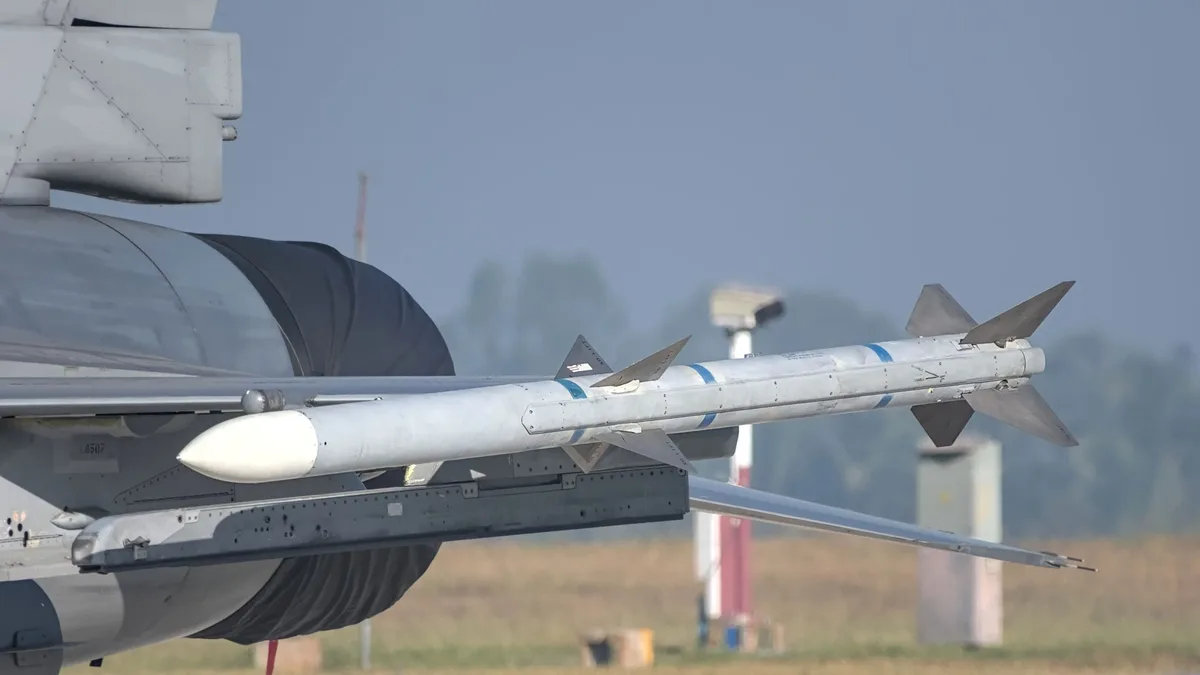
Pakistan successfully tested its first indigenously developed beyond-visual-range air-to-air missile, the Fa’az, on November 3, 2026. The launch from a Pakistan Air Force JF-17 Thunder Block-1 aircraft, serial number 09-109, marks the country's entry into an elite group of nations capable of producing such weapons.
President Asif Ali Zardari, Prime Minister Shehbaz Sharif, and Field Marshal Asim Munir congratulated the development team. The test, announced by the Inter-Services Public Relations and the PAF press wing, enhances operational flexibility and demonstrates technical maturity. It comes as Pakistan expands indigenous weapons production following a military confrontation with India in May 2025. The homegrown Fa’az allows the PAF to maintain a large stockpile, resolving concerns about running out of missiles when countering threats from India's air force.
Relying on foreign vendors poses high costs and competitive risks. The PAF, though numerically smaller than the Indian Air Force, focuses on technological innovation to offset this asymmetry. The Fa’az is a key initiative to respond to evolving threats along Pakistan’s eastern border. The tested variant is the Fa’az-IIR, featuring an imaging infrared seeker.
Technical Capabilities and Development
The Fa’az-IIR variant achieves a speed of Mach 3.5 with an operational range of over 100 kilometres. It uses the launching aircraft’s fire-control radar for mid-course updates before activating its internal infrared seeker in the terminal phase. This 'lock-on after launch' approach and infrared guidance make the missile more resistant to jamming than radar-guided types.
Pakistan’s military media wing stated the "Fa’az is equipped with an advanced terminal guidance system and can engage aerial targets at extended ranges." The Air Weapons Complex, operating under the National Engineering and Scientific Commission, is the missile's principal developer. The programme's intended platform options include possible integration with the J-10CE fighter.
| Variant | Stated Range |
|---|---|
| FAAZ-1 series | Exceeding 100 km |
| FAAZ-2 | Approximately 180 km |
Regional Context and Countermeasures
Pakistan's missile development emerges amid India's induction of advanced platforms. The Indian Air Force plans to operationalize the indigenously built CATS Warrior unmanned combat aerial vehicle, using Rafale fighter jets as mother ships to guide them for strikes. India also plans to purchase 114 additional, more advanced F4-standard Rafale fighters.
In response, the PAF plans to use a combination of radar-guided Pl-15E and infrared-guided Fa’az IIR missiles in future engagements. Evading two different types of modern missiles presents a significant challenge. India is concurrently building its own Astra family of BVR missiles. The Astra Mk-2, with a range of 200 kilometres, is expected to enter service soon, with up to 700 units planned for induction. Work is also underway on the Astra Mk-3, with a range of 350 kilometres.
Indigenous Defense Industry Progress
The Fa’az program reflects Pakistan's broader strategy of technological self-reliance. The successful flight test strengthens Pakistan's position as a developer of sophisticated airborne weapons. Pakistan is also working with Turkey on BVR missile technology, where its Global Industrial and Defence Solutions is developing the Fa'az-2 and Turkey's Tubitak Sage is developing the Gokdogan missile. Reports suggest the two nations may combine elements of their designs, though the tested Fa’az is treated as a separate system from the Fa’az-2.
The test occurred after the Fatah-2 ER ballistic missile test on October 13, 2026. The JF-17 Thunder, a jointly built aircraft by Pakistan and China, serves as the backbone of the country’s combat aviation. The strategic value of seeker diversity lies in the possibility of a more adaptable indigenous arsenal for long-term air defense autonomy.