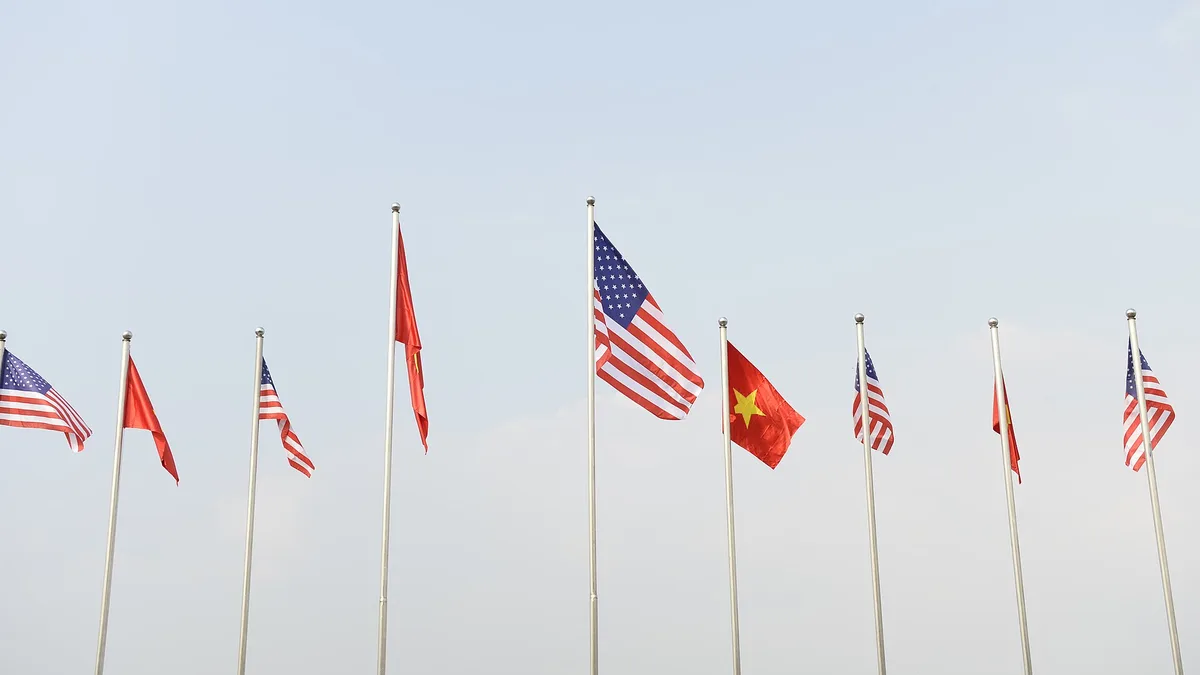
Vietnam
| Capital | Hanoi |
|---|---|
| Official language | Vietnamese |
| Government system | Unitary Marxist–Leninist one-party socialist republic |
| Area | Approximately 331,212 square kilometers |
| Population | Over 98 million |
| Currency | Vietnamese đồng (VND) |
| Time zone | Indochina Time (ICT, UTC+7) |
| Driving side | Right |
Overview
Vietnam is a sovereign state located in Southeast Asia on the eastern margin of the Indochinese Peninsula. It is bordered by China to the north, Laos and Cambodia to the west, and the South China Sea to the east. The country operates as a unitary Marxist–Leninist one-party socialist republic, with the Communist Party of Vietnam constitutionally enshrined as the leading force in state and society. Its political structure is characterized by a strong central government, a National Assembly as the highest representative body, and a parallel system of party and state administration. The Vietnamese economy has undergone significant transformation since the late 20th century, moving from a centrally planned model to a socialist-oriented market economy, which has spurred rapid industrialization and export-led growth. With a population exceeding 98 million, Vietnam is demographically young and exhibits significant cultural and linguistic diversity across its regions.
History
The origins of the modern Vietnamese state are rooted in the ancient Red River Delta civilization, with the first sustained independent polity emerging as the Kingdom of Âu Lạc in the 3rd century BCE. A millennium of Chinese domination followed, profoundly influencing Vietnamese culture and administrative systems, before the re-establishment of independence under the Ngô dynasty in the 10th century CE. The nation gradually expanded southward (Nam Tiến) over subsequent centuries, absorbing the Champa civilization and parts of the Khmer Empire. The modern period was defined by French colonial rule from the mid-19th century until the mid-20th century, a period of significant economic exploitation and cultural influence. Following World War II, the First Indochina War culminated in the 1954 Geneva Accords, which temporarily divided the country at the 17th parallel, leading to the separate states of North Vietnam (the Democratic Republic of Vietnam) and South Vietnam (the Republic of Vietnam). The subsequent Vietnam War, ending in 1975 with the fall of Saigon, was followed by reunification under communist rule in 1976, though significant economic challenges persisted until the introduction of the Đổi Mới (Renovation) reform policies in the mid-1980s.
How it works today
The government of Vietnam is structured under the 2013 Constitution, which vests state power in the people, exercised through the National Assembly, elected local people's councils, and a complex hierarchy of state administrative bodies. The National Assembly, a unicameral legislature, holds the highest constitutional authority, responsible for making laws, electing key officials like the President and Prime Minister, and overseeing state operations. Executive power is vested in the government, led by the Prime Minister, which manages the day-to-day administration of the state. The judicial system is headed by the Supreme People's Court and operates alongside the Supreme People's Procuracy, which handles prosecution and legal supervision. The Communist Party of Vietnam permeates all levels of this structure through its Politburo, Central Committee, and grassroots party cells, setting national policy direction and personnel appointments. Economic management is conducted through a socialist-oriented market economy, where the state retains a commanding role in key sectors while encouraging private enterprise and foreign direct investment, particularly in manufacturing and technology.
Why it matters
Vietnam holds significant geopolitical importance due to its strategic location along vital maritime routes in the South China Sea, a major global trade corridor and a region of ongoing territorial disputes. Its rapid economic growth and integration into global supply chains, notably as a major exporter of electronics, textiles, and agricultural products, make it a critical node in the world economy. The country's political model offers a distinct case study of a single-party state successfully implementing market-oriented economic reforms while maintaining tight political control, influencing debates on development paths. Demographically, its large, youthful population represents both a substantial labor force and a growing consumer market, attracting sustained foreign investment. Vietnam's historical experience with colonialism and war, and its subsequent development trajectory, provide important insights into post-conflict nation-building and the challenges of modernization. Furthermore, its foreign policy of "multilateralization and diversification" positions it as a key balancing actor in the complex diplomatic landscape of Southeast Asia amid major power competition.
Common misconceptions
A common misconception is that Vietnam's economic system is purely capitalist; in reality, the state maintains direct control over large swaths of the economy through state-owned enterprises and the party's decisive role in economic planning. Another is the belief that the country is culturally and politically monolithic, when in fact there are pronounced regional differences in dialect, custom, and economic development between the north, central, and southern regions. Many outsiders assume the Vietnam War defines the entirety of modern Vietnamese identity, overlooking millennia of pre-colonial history and the profound social and economic transformations of the post-war Đổi Mới era. It is also incorrectly thought that political dissent is entirely absent; while organized opposition is not permitted, there are ongoing debates and criticisms within official channels and a vibrant, though circumscribed, civil society. The nature of the one-party state is often oversimplified, ignoring the complex internal dynamics, factional politics, and policy debates that occur within the Communist Party's framework. Finally, the country's foreign policy is frequently mischaracterized as aligning firmly with one major power, whereas its official stance is one of "independence, self-reliance," and active participation in multiple international partnerships to maintain strategic autonomy.
Latest Vietnam news
Latest reporting
Myanmar President Concludes State Visit to Vietnam
Myanmar's military-appointed President Min Aung Hlaing concluded a three-day state visit to Vietnam, where leaders agreed to raise defense and...
Asian Leaders with Chinese Education
A growing number of top leaders in South Korea, Laos, Kazakhstan, and Vietnam have studied at Chinese universities.
Vietnam and Australia Strengthen Comprehensive Strategic Partnership
The recent visit of Vietnamese President To Lam to Australia has resulted in the signing of three joint statements, marking a significant milestone...