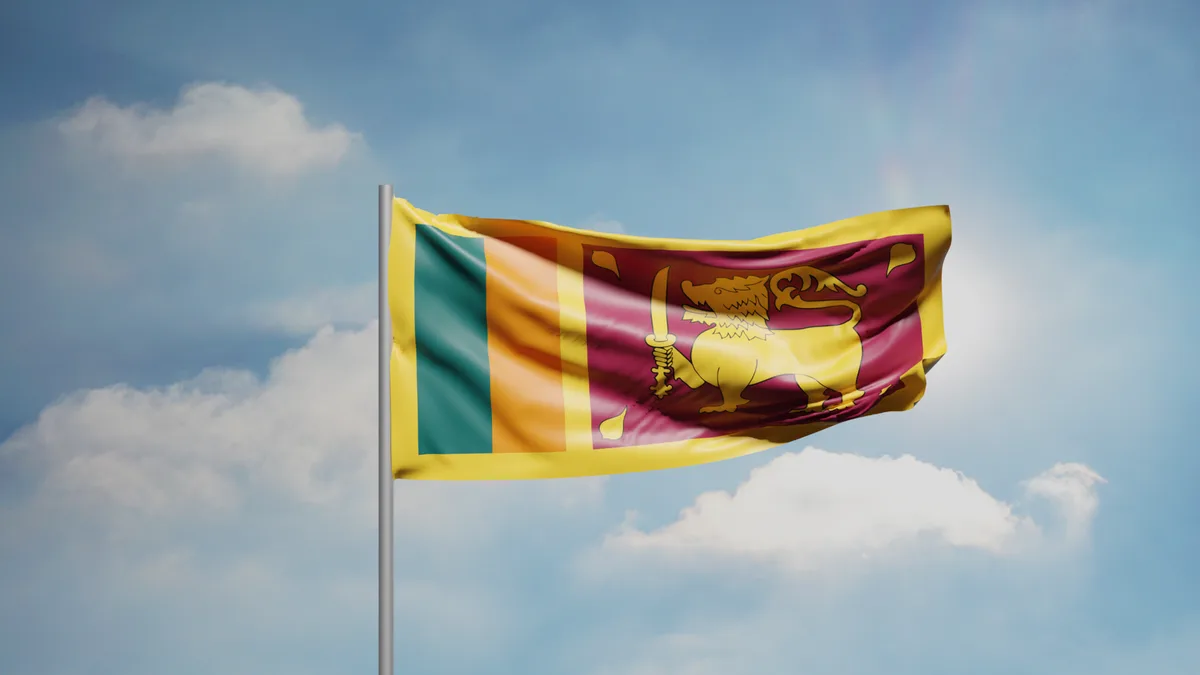
Sri Lanka
| Capital | Sri Jayawardenepura Kote (administrative), Colombo (commercial) |
|---|---|
| Official languages | Sinhala, Tamil |
| Government | Unitary semi-presidential republic |
| Population | Approximately 22 million |
| Area | 65,610 km² |
| Currency | Sri Lankan rupee (LKR) |
| Driving side | Left |
Overview
Sri Lanka is an island nation located in the Indian Ocean, southeast of the Indian subcontinent. It is a sovereign state with a democratic form of government, operating as a semi-presidential republic. The country's landscape is diverse, featuring coastal plains, a central mountainous region, and significant biodiversity. Its economy has historically been driven by agriculture, notably tea, rubber, and coconut, though it has expanded into sectors like apparel manufacturing and tourism. The population is multi-ethnic and multi-religious, primarily comprising Sinhalese, Tamil, and Muslim communities. The capital of Sri Lanka is Sri Jayawardenepura Kotte, which houses the administrative capital and parliament, while Colombo serves as the commercial capital.
History
The island has a documented history spanning over three millennia, with early chronicles describing settlements by ancient peoples. It was known in historical and geographical contexts by various names, including Taprobane to the Greeks and Serendib to Arab traders. The Sinhalese kingdoms, with their origins in migrations from northern India around the 5th century BCE, established advanced hydraulic civilizations in the dry zone. The Tamil presence on the island also dates back many centuries, with established kingdoms in the north and east. European colonial rule began in the 16th century with Portuguese and later Dutch coastal control, followed by the British who gained control of the entire island in the early 19th century. The country gained independence from British rule in 1948 and adopted the name Sri Lanka in 1972, becoming a republic.
How it works today
Sri Lanka's government operates under a constitution that establishes a semi-presidential system, where executive power is shared between a directly elected President and a Prime Minister who commands a majority in Parliament. The legislative body is a unicameral Parliament, whose members are elected through a proportional representation system. The judiciary is independent, with a Supreme Court serving as the highest court of record. Administratively, the country is divided into nine provinces and further subdivided into districts. The economy faces significant challenges, including high public debt and balance of payments pressures, with key exports being textiles, tea, and spices. Civil society and media operate within a framework that has faced international scrutiny regarding freedom of expression and human rights.
Why it matters
Sri Lanka holds strategic geopolitical importance due to its location along major shipping lanes in the Indian Ocean, making it a focal point for regional security and trade dynamics. The country's multi-ethnic democracy represents a complex case study in post-colonial state-building and managing majoritarian politics within a diverse society. Its experience with a prolonged internal conflict and subsequent reconciliation efforts provides critical lessons for transitional justice and peacebuilding processes globally. As a significant producer and exporter of tea, rubber, and cinnamon, Sri Lanka plays a notable role in global commodity markets. The nation's rich biodiversity, including several UNESCO World Heritage sites, contributes to global ecological conservation efforts. Furthermore, its recurring economic crises offer important insights into the vulnerabilities of small, developing states within the global financial architecture.
Common misconceptions
A common misconception is that the ethnic conflict was simply a religious war between Buddhists and Hindus, whereas it was fundamentally a political struggle over identity, power-sharing, and territorial rights between the Sinhalese-majority state and Tamil separatist groups. Another error is viewing the colonial period as a monolithic experience, when in fact Portuguese, Dutch, and British rule each introduced distinct administrative, legal, and social changes over different periods and regions. It is also inaccurate to characterize the entire island as uniformly tropical; the central highlands feature a temperate climate and topography distinct from the coastal lowlands. Many incorrectly assume the civil war ended with a comprehensive political solution, whereas the military conclusion left core grievances regarding governance and accountability largely unresolved. There is a tendency to oversimplify the economic crisis as solely stemming from recent events, ignoring deep-rooted structural issues like fiscal mismanagement and export concentration developed over decades. Finally, it is a mistake to conflate all Tamil people with support for separatism, as Tamil political opinion encompasses a wide spectrum, including federalist and integrationist perspectives.