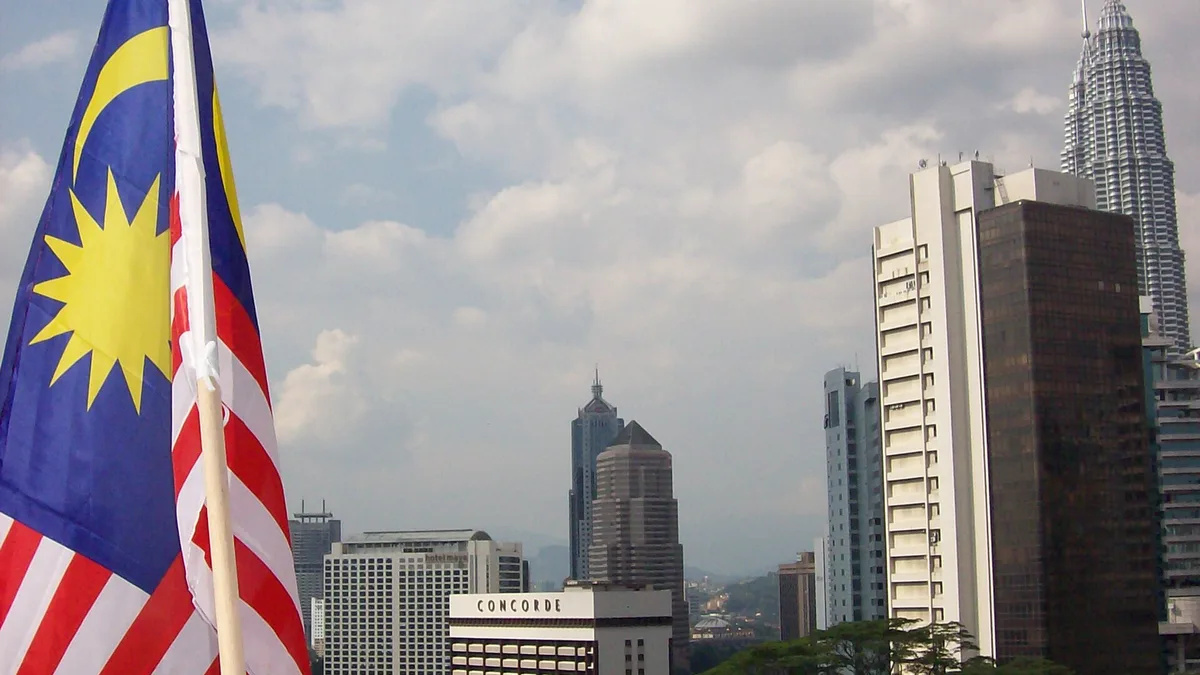
Malaysia
| Capital | Kuala Lumpur (Putrajaya is federal administrative centre) |
|---|---|
| Official language | Malay |
| Government | Federal parliamentary constitutional monarchy |
| Currency | Malaysian ringgit (MYR) |
| Population | Approximately 33 million |
| Major ethnic groups | Malay, Chinese, Indian |
| Area | Approximately 330,000 km² |
Overview
Malaysia is a federal constitutional monarchy located in Southeast Asia, consisting of two distinct landmasses separated by the South China Sea. The country comprises thirteen states and three federal territories, with its political system incorporating both elective and hereditary elements. Its head of state, the Yang di-Pertuan Agong, is a monarch elected for a five-year term from among the nine hereditary rulers of the Malay states. The federal government operates under a Westminster-style parliamentary democracy, with a bicameral legislature and a prime minister as head of government. Malaysia's legal system is a complex amalgamation of common law, Islamic law, and customary law, reflecting its multi-ethnic population. The nation's economy is diversified, with significant sectors in electronics, commodities, and financial services, moving beyond its historical reliance on natural resources.
History
The modern nation-state of Malaysia originated from a series of British colonial territories in the Malay Peninsula and northern Borneo. Key historical entities included the Straits Settlements, the Federated Malay States, and the Unfederated Malay States, which were consolidated under British influence by the early 20th century. Following Japanese occupation during World War II, post-war decolonization led to the formation of the Federation of Malaya, which gained independence from Britain in 1957. In 1963, the federation was expanded through the formation of Malaysia, incorporating the Bornean states of Sabah and Sarawak and the island of Singapore; Singapore separated from the federation in 1965. The post-independence period has been dominated by the Barisan Nasional coalition, which maintained power for decades until a historic electoral change in 2018. The country's history is marked by efforts to balance the political dominance of the ethnic Malay majority with the rights and economic participation of significant Chinese and Indian communities.
How it works today
Today, Malaysia functions as a federal constitutional monarchy where executive power is vested in the Prime Minister and the Cabinet, drawn from the elected members of parliament. The Parliament consists of the Dewan Rakyat (House of Representatives) and the Dewan Negara (Senate), with the former being the primary legislative body whose members are elected from single-member constituencies. The judiciary is independent in principle, headed by the Federal Court, though it has faced persistent allegations of political influence over high-profile cases. State governments have authority over matters such as land, religion, and local government, while federal power covers foreign policy, defense, finance, and internal security. The Islamic legal system operates in parallel for Muslims in personal and family law matters, administered by state-level Sharia courts. Regular general elections are held, though the electoral system and delineation of constituencies have been subjects of ongoing controversy and legal challenges.
Pros and cons
A significant advantage of Malaysia's system is its relative political stability and consistent economic growth within the Southeast Asian region, providing a predictable environment for business and investment. The multi-ethnic society, while sometimes tense, has generally maintained social cohesion and offers a rich diversity of cultures, languages, and cuisines. However, a major con is the pervasive issue of corruption and cronyism within political and business elites, which distorts economic competition and undermines public trust in institutions. The affirmative action policies, originally designed to uplift the ethnic Malay majority, are often criticized for creating economic inefficiencies and perpetuating a sense of grievance among minority communities. The legal and political framework can be slow to reform, with sedition and other broadly defined laws sometimes used to stifle legitimate dissent and criticism. Many citizens and observers regret the entrenched patronage politics that can prioritize party loyalty over meritocracy in public appointments and government contracts.
Who it suits
The Malaysian political and social system suits those who prioritize gradual, evolutionary change over revolutionary reform, and who can navigate its complex, relationship-driven business and bureaucratic landscapes. It is an environment suited for individuals and businesses comfortable operating within a framework where informal networks and understanding of communal sensitivities are as important as formal rules. The system generally benefits those from the majority ethnic group who qualify for and support the longstanding affirmative action policies in education and economic participation. It is less suited for staunch secularists or those advocating for a strict separation of religion and state, given the entrenched role of Islam in public life and law. The environment can be challenging for activists and journalists focused on transparent governance and absolute freedom of expression, who often face legal and administrative obstacles. Ultimately, it suits pragmatic individuals who accept the trade-offs between stability, ethnic-based preferences, and the pace of democratic liberalization.